Treating pond fish ulcers

Treating pond fish and koi ulcers and wounds
I am new to Koi keeping and have just finished building my first Koi pond. I have stocked it with Koi and I hope I will be able to provide a good home for them. I have become concerned about one of the Koi though because a small ulcer has appeared. The range of medications available to Koi keepers like me is baffling; Which ones treat which conditions? Do I need to isolate this particular Koi to treat it or should I treat the whole pond? And what are the right dosage rates for all the different medications? Can you give me a foolproof guide to treating my Koi?
One of the many attractions of Koi keeping is the number of different challenges that we may have to face from a wide number of disciplines. One such challenge is to understand fish disease and fish biology, and from your short letter, it sounds as though your steep learning curve starts here, so soon after completing your new pond.
You will come to notice how changes to your pond environment (such as those encountered in a maturing pond or during the addition of new Koi) can have a knock-on effect on the fish health in your pond. It is highly likely that the ulcer that you describe has arisen as a result of stresses that have affected that individual Koi prior to purchase and during acclimatisation to your new pond. But you should also keep a regular check on your pond’s water quality where it matures as a deterioration will make all of your Koi susceptible to disease, including ulcers.
Before you even consider using any medications, you should be satisfied that your pond conditions are ideal for Koi, and that they are not a contributory factor to the poor health status of your Koi. If your water quality tests do highlight a problem, then address this first and rectify it, as medications will not be successful if your Koi are constantly being stressed.
Whenever I treat fish, I find it helpful to think of successful disease treatment as a partnership between medications and the fish themselves. By doing so, you’ll soon realise that the medication will only treat the disease organisms, leaving the Koi to heal itself; something it can only do under the correct supportive pond conditions.
I completely agree with you at being been baffled by the vast array of different medications and pond treatments available. Perhaps the most useful thing you can do at this stage is to investigate the likely causes of ulcers, and then look at the treatment options. This will certainly narrow down your focus straightaway. In fact, there is a four-stage approach to successfully treating a range of diseases that you can apply to your current Koi health problem as well as those that you may experience in the future.
1. Accurate diagnosis. If having been alerted by either behavioural changes or physical abnormalities, (and if you are able to), take a mucus scrape and examine it under a microscope. This will identify a definite organism which you will need to treat (otherwise you will be diagnosing by using an educated guess or experience which is not 100% reliable).
2. Choose the correct treatment. Having identified the pathogen(s) causing your Koi a problem, you can now target those organisms accurately.
3. Apply the correct dose and treatment regime. This will invariably involve calculating the volume of your pond and filter system and taking proactive action to ensure that the addition of any medication does not stress the fish further (by adding aeration, bypassing the biofilter if required etc). Some pathogens (usually external parasites) will also require a treatment programme to eradicate than, rather than one or two discrete pond treatments.
4. Monitor the fish’s response to medication and respond accordingly. This also involves monitoring all other Koi in your pond to ensure that their health status does not deteriorate while the pond is being treated.
Ulcers.
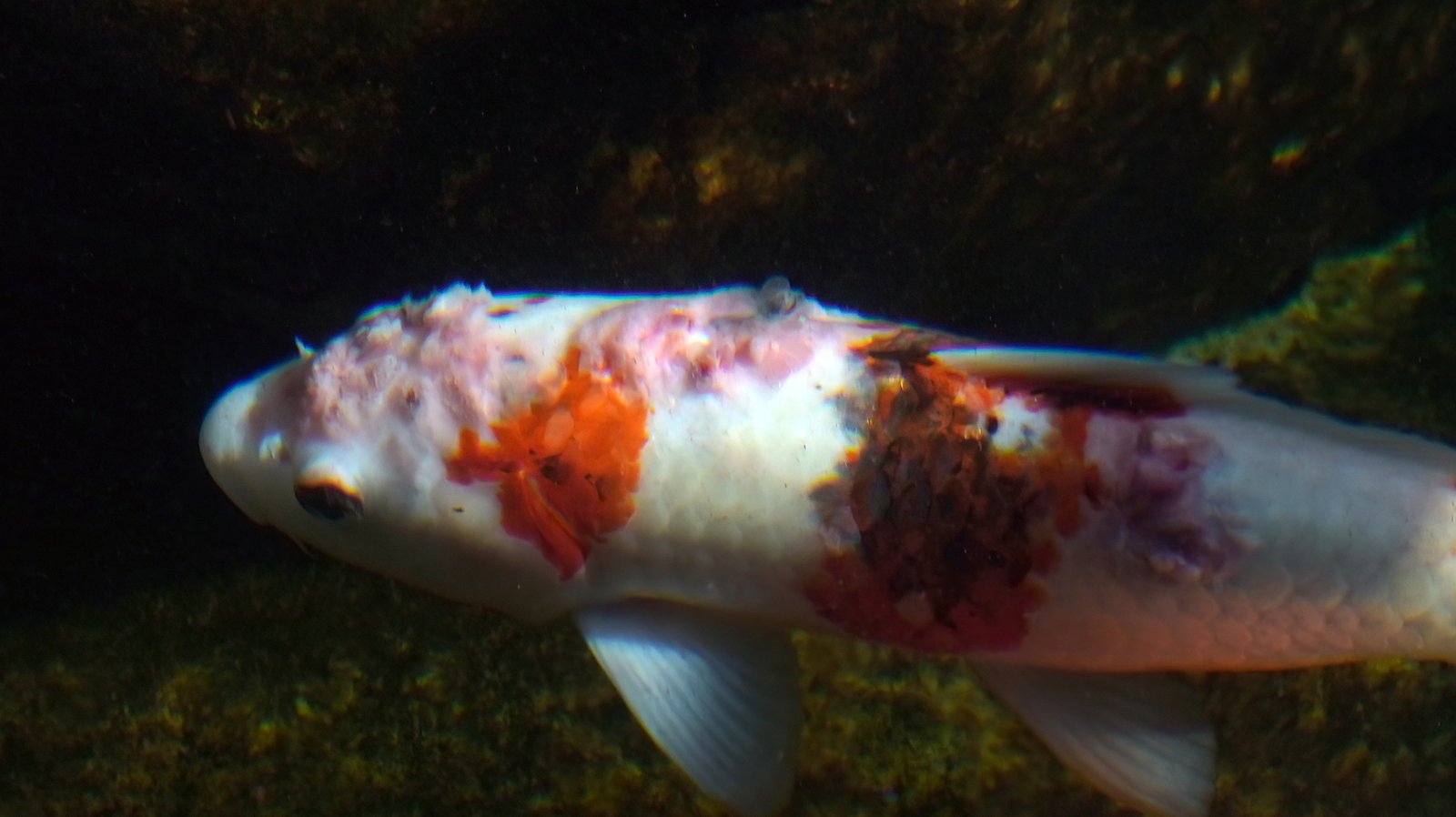
Ulcers are a symptom of a bacterial infection (usually internal) that will have come about by your Koi becoming stressed and susceptible to pathogenic bacteria. It can also be a secondary health problem that arises after lesions created by parasites have become infected. Even so, ulcers can grow rapidly on a Koi and spread to other Koi in the pond so rapid treatment and isolation is recommended.
Ulcer treatment – A three-pronged attack.
Having isolated your Koi in a suitably sized and filtered quarantine system you should do following:
1. Add salt to the quarantine system (see table for correct dose). This will perform 2 useful roles.
a. Acts as a mild antiseptic that will help to keep the wound clean of pathogenic bacteria.
b. Reduces the amount of fluid that is lost directly through the open ulcer by reducing the osmotic gradient between the pond water and Koi tissue. This will help reduce stress for the Koi.
2. Add a broad-spectrum anti-bacterial pond treatments such as acriflavine or malachite green to back up the salt in it’s action against bacteria.
3. Apply a topical treatment directly on to the ulcer. This will involve anaesthetising your affected Koi, removing dead tissue and scales. Add a combination of a waterproof ointment on to the wound (Orabase) and an anti-bacterial topical treatment (concentrated malachite green). This will need to be replaced every other day or so, being careful not to disturb the healing wound. To support the Koi’s healing, offer a good food and raise the water temperature to 20-25 degrees C and aerate vigorously.
Depending on the severity of the bacterial infection and how virulent the bacteria are, you may also be advised to seek a Vet’s advice regarding the injection of a suitable antibiotic. This will also depend on the value and size of your Koi as a Vet’s consultation and antibiotics are not inexpensive.
As you can see, once you’ve diagnosed the cause of your Koi’s health problem (and in doing so identified the causative pathogenic organism) you only need be concerned with two-to-three different treatments for that disease.
When looking at the vast array of treatments and chemicals available through a Koi dealer, you will notice that they fall into two categories.
1. Treatments that consist of a single or a combination of chemicals and are described by their chemical name (Acriflavine, malachite green, chloramine T). These treatments require some background knowledge as to what they treat and as to how to use them.
2. Treatments that are described by what they treat. Eg White spot treatment, Fungus treatment etc. These are of course easy-to-follow and in most cases consist of a combination of the chemicals mentioned in the first list. Their formulations may also include a few novel (even patented) ingredients which can demand a higher price. It is perhaps a vast array of treatments available under different brand names that is confusing or baffling. Most Koi keepers choose a couple of treatments for each type of pathogen (i.e. bacteria, parasites, fungi) and use them when required as tried and trusted remedies.
Either way, most pond treatments are toxic to your Koi as well as to their targeted pathogen, with their toxicity being a factor of their concentration in pond water. Consequently, whether you’re using a base chemical treatment or a branded treatment, always read the label and double-check dose rates and treatment regimes before starting on a course of treatment. You will also find it helpful to keep a log or diary of pond treatments used, and the results achieved. By doing so, a handful of favourite pond treatments will become apparent, making it easier for you to make sense of the baffling array of treatments available.
10 Top tips for successfully treating Koi
1. Regularly watch your Koi for changes in behaviour – an early indicator of disease.
2. Diagnose accurately, using specific diagnostic techniques (microscope etc)
3. Know your pond volume, and dose accurately.
4. Choose your treatment wisely. Is it tried and trusted? What is the recognised successful treatment programme?
5. Aerate when treating your Koi pond as DO drops during medications
6. Continue to monitor all Koi during treatment and respond to any acute behavioural changes during treatment.
7. Koi can become frisky during treatment. Prevent them from jumping out of your pond by covering it with a net.
8. So that Koi can heal themselves after you’ve treated the pathogen, support them with excellent water quality and nutrition
9. Turn off your UVc and by-pass your biofilter if recommended to do so by treatment directions.
10. Keep a diary of diseases and successful treatments – learn from your successes and mistakes.