Koi kidneys and liver

Kidneys and Liver – Caring for the Koi’s own filtration system.
A koi’s physiology never rests. It is fighting an endless battle on many fronts in an aquatic environment that exerts a continuous barrage upon its body. A koi’s internal physiological processes demand a consistent body chemistry in which to perform effectively (and is the reason why we must endeavour to provide a stable pond environment). If a koi’s body composition is allowed to get out of balance, it is also likely to lose its grip on health. Koi must continually respond to normal pressures on their physiology to maintain a stable body state, even in the most ‘perfect’ of water conditions, otherwise the composition of their internal tissues would deteriorate and start to malfunction.
Two key organs that help koi maintain a stable and satisfactory internal tissue composition are the kidneys and liver. They both perform different yet complimentary roles for koi, and by understanding the roles they play in maintaining koi health, we can also appreciate how our actions as koi keepers can affect each organ and ultimately influence a koi’s health status.
It is useful to look at the liver and kidneys together as (besides other things) they both perform a filtering or removal function for koi. The kidneys filter the blood, ultimately retaining the required solutes within the blood such as sugars, amino acids and even ammonia (to be excreted later via the gills). The resultant dilute filtrate is excreted in solution through the rear-most of the 3 pores that make up the vent area. (The other 2 being the opening to the gut and the reproductive organs).
The liver is a ‘Jack of all Trades’, performing many roles including the detoxification of complex compounds, storage of glycogen (the storage form of glucose) and is the centre of accumulation of many toxic elements, particularly heavy metals.
Compared to more visible features such as skin quality and colour or body shape and size, internal organs are concealed within the body cavity making it impossible to assess their condition visually. All the more reason why we need to be aware of their requirements and care.
The kidneys, compared to what we might expect are long and narrow in structure, running the length of the body cavity just below the spine. The liver is a more typical ‘organ’ shape, consisting of several lobes, situated between the intestine and the reproductive organs. As these vital organs are so well hidden, we must do our utmost to take care of them so they will continue to take care of our koi.
Kidney function and care.
The composition and quality of the water in our pond will probably have the largest impact on the function and health of a koi’s kidneys. Koi are faced with the same problems as other freshwater fish, in that the composition of their body fluids is far more concentrated than the water that surrounds them. This means that through osmosis, there is a natural and passive tendency for water to move across a semi-permeable membrane such as the gills, entering the blood and diluting it. If left unaddressed, koi would accumulate water to such an extent that their blood would thin and their body shape bloat, leading ultimately to the koi’s death.
What is Osmosis?
Osmosis is the net movement of water from an area of high water concentration (e.g. pond water) to an area of low water concentration (e.g. fish tissue). Osmosis will occur wherever there is such a difference in water concentrations, separated by a semi-permeable membrane (ie a barrier that only lets specific compounds through such as gill tissue).
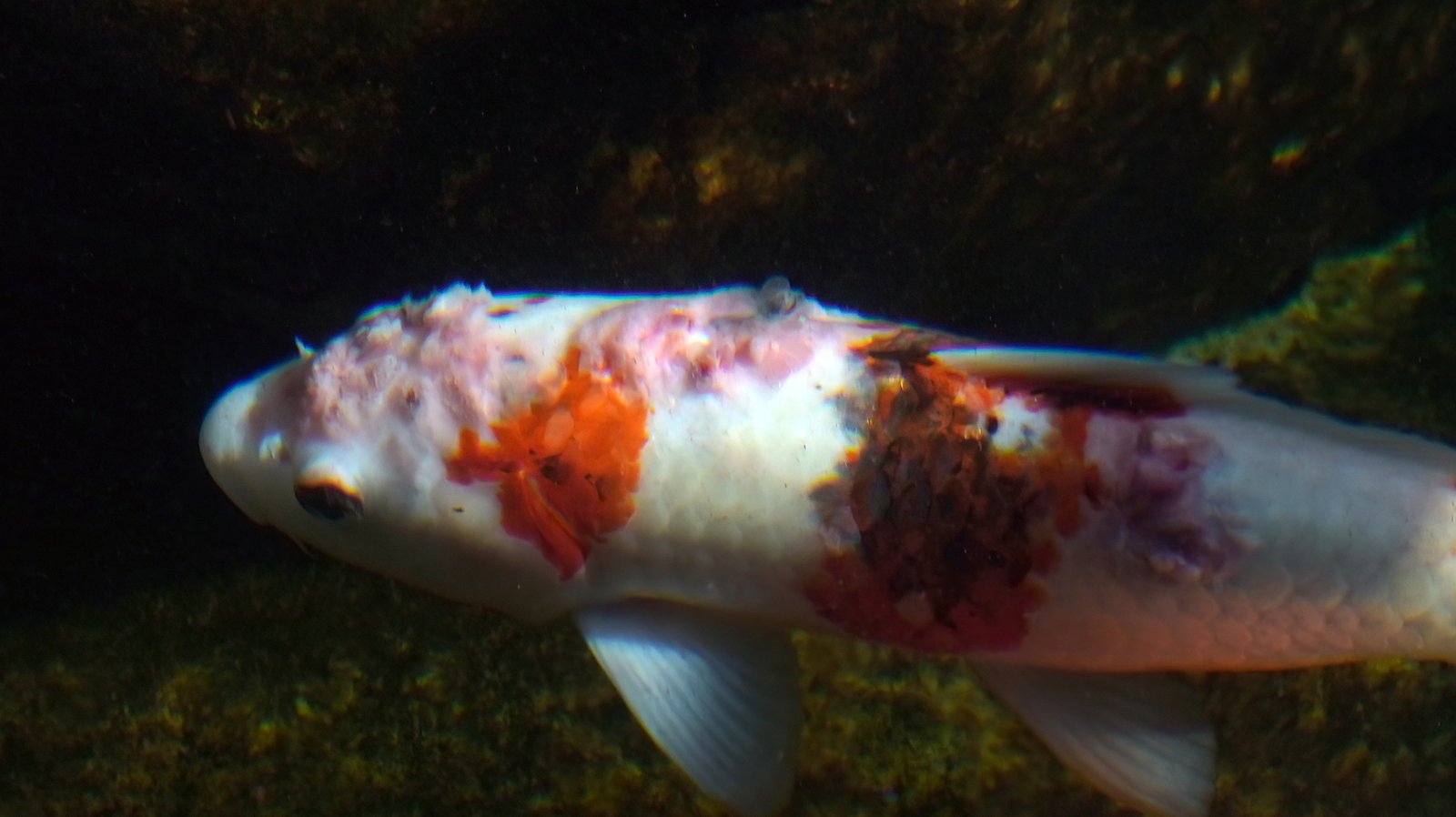
As osmosis occurs all the time, then the kidneys need to filter out the water at the same rate that it accumulates in the blood, thereby keeping the koi’s tissue concentration relatively constant. Consequently, koi (and other freshwater fish) will excrete large quantities of very dilute urine. As long as koi are healthy, they can handle the workload that is required of the kidneys. However, if the rate of water influx into the koi tissues exceeds the normal amounts that would enter across the gills, then the kidneys could become overworked and stressed as they try to filter excess water from the rapidly thinning blood. This is often the case with koi that are suffering from ulcers.
The impact of ulcers on kidney function.
Caused by an internal bacterial infection or an infected abrasion, an ulcer represents a real threat to the kidneys and the health and well being of a koi. An ulcer forms through the bacterial action on a localised area of the skin, and is a site of excessive water uptake via osmosis, over and above what is experienced at the gills. As it is the kidney’s role to filter and excrete water from the rapidly diluting blood, they have to work overtime to maintain a balance (See Figure 1). We need to intervene to aid the kidneys, or else the koi may be lost through kidney failure (rather than by the initial bacterial infection).
What can we do to aid the kidneys in a koi suffering from ulcers?
We need to reduce the workload of the kidneys as soon as possible and this can be achieved in a number of ways.
1. Apply an impermeable dressing to the ulcer. This will reduce the rate at which water is able to enter fish tissue through the ulcer. Furthermore, if an antibacterial treatment can be applied topically, this will reduce the infection and aid the fish in its healing process. As long as an ulcer is exposed to the water, the kidneys must work overtime to maintain a stable body composition.
2. Add a mild salt solution to the pond. Dosing the pond with salt at a rate of 10g/litre (1%) will perform two functions.
a. Firstly, it will act as a mild anti-septic aiding the healing of the wound or ulcer.
b. The salt will reduce the concentration gradient between the koi tissue fluid and the pond water, reducing the rate at which water will enter the fish via the ulcer and gills by osmosis and the workload the kidneys have to perform to maintain a balance.
Always supply additional aeration when salting a pond, and look at it as a short term measure, planning on diluting it away after the ulcer has healed.
Bloated Koi.
Individual koi can sometimes accumulate excessive tissue fluid within their bodies, causing them to bloat and swell, often causing the eyes to protrude and the scales to lift. This is most likely caused by a kidney malfunction and as it is internal, can be difficult if not impossible to accurately diagnose and treat effectively. Occasionally koi can recover, but by the same token, the condition can deteriorate over a matter of days , proving fatal in most cases.
Liver.
The liver cleans up the blood by breaking down old blood cells, detoxifying those complex compounds that it can break down, or by storing other toxic elements. As a consequence, the liver is the organ that is most likely to accumulate toxic metals that are present in the environment. Over time, such accumulation can lead to abnormal growth (tumour) of liver tissue and in extreme cases, necrosis (localised death) of cells within the liver itself.
The liver is also an area where excess lipid is stored if koi are offered a diet that is too high in energy relative to their requirements. The liver (and other organs) can become burdened with fat, altering the body shape and composition and also placing a burden on the liver and other vital organs.
Care for the liver can include installing an in-line water purifier to remove heavy metals from tapwater or the use of effective water treatments that will bind up heavy metals, taking them out of circulation. A well balanced diet will also reduce the risk of the accumulation of fat around the liver, enhancing its function.
In summary, koi work hard to maintain a stable internal tissue composition which has direct implications for their overall health. If we can support a koi’s filtering organs (kidneys and liver) by observing a handful of golden rules, these vital organs will continue to support a koi’s health for many years to come.