Koi external anatomy

Head to tail trip over a koi’s external anatomy
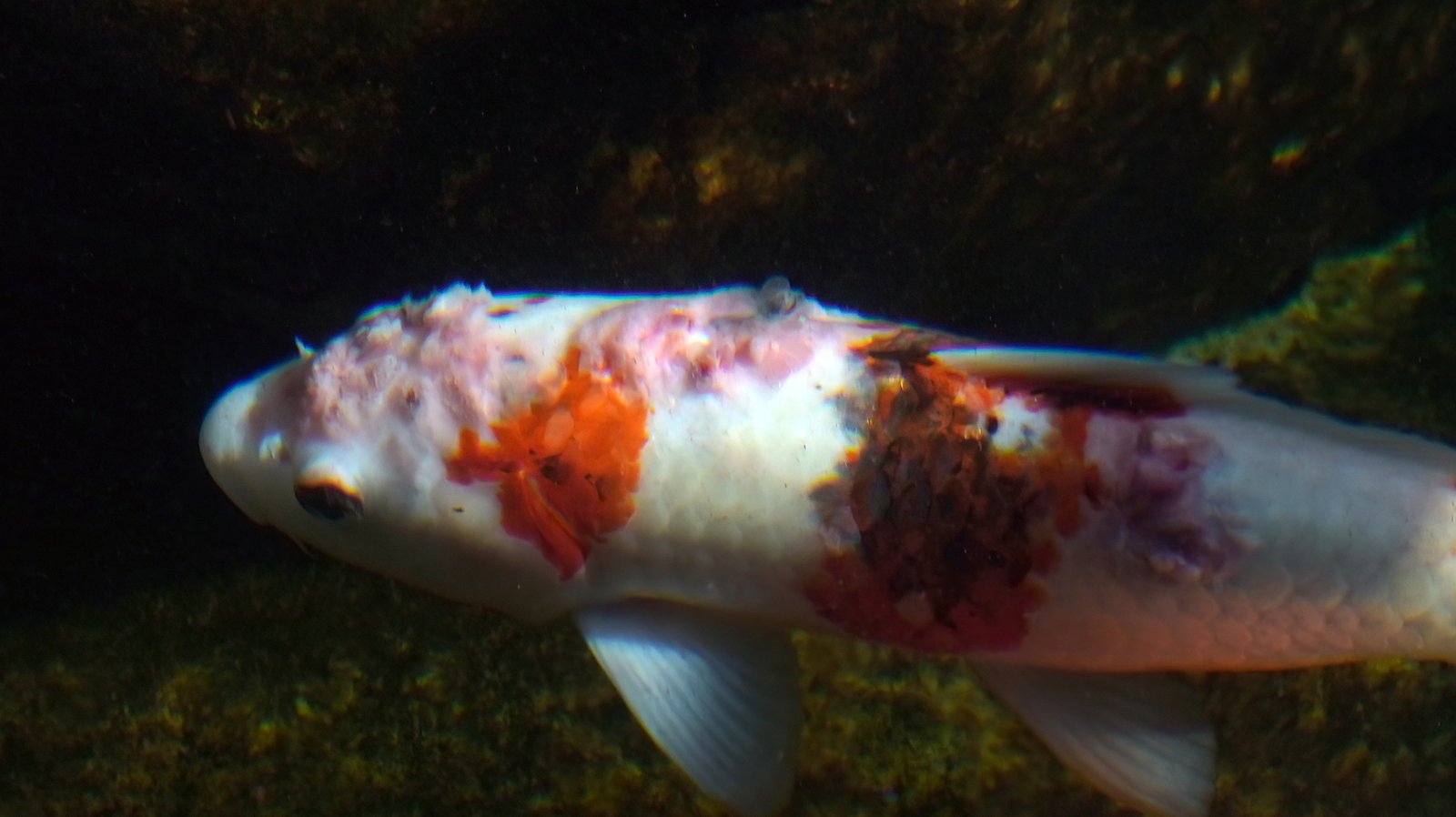
Koi have earned a status above other fish on the strength of their beauty, grace and value. Over many generations, the expert breeding and rearing skills of the Niigata koi farmers have led us to expect the shape, pattern and colour of koi to improve on that of the previous years. When viewing a koi, we are largely concerned with the koi’s external appearance – making special reference to a koi’s skin quality, pattern, depth of colour and lustre. Yet even though we are pre-occupied with a koi’s external features, we may pay little attention to the key external features that koi actually share with most other fish (even though they are quite literally a breed apart). Fortunately, apart from minor cases of physical deformity, genetics play a far greater role in determining variations in colour compared to any variations in their external anatomy, with each koi exhibiting the same external body parts, each of which has an essential role to play in a koi’s life.
Travelling from head to tail, these features include:
1. Mouth. Koi possess a protrusible, inferior mouth. This means that it is downturned and slightly distensible, making them very well suited to feeding off the pond bottom (without actually having to touch the pond bottom with the rest of their body). Koi have no visible teeth around the rim of the mouth which is typical of a scavenger (compared to a predator), slurping and sucking up its food. When we offer our koi a floating food (so we can view our fish and reduce the risk of overfeeding) we are actually forcing koi to use their mouths in a way they were not designed for – hence their ungainly style when feeding on a floating food.
2. Barbels. Koi possess 4 barbels (2 different pairs), one set of which is far more apparent than the smaller upper pair. Attached to each corner of the mouth, the barbels perform a chemosensory role, detecting and tasting potential food items prior to ingesting them. Equipped with taste buds, the barbels are able to locate food in the murky, silt-laden depths of a muddy natural pond, being thrust downward into the silt with the protrusible mouth.
3. Nose and nostrils. These act in unison with the barbels, sensing and detecting chemical changes in the water, performing a ‘long distance taste’ of soluble substances (including food) that are carried in the water. Unlike our own nostrils, koi have 4 openings, arranged in 2 pairs with the water entering the anterior nostril, deflected by the flap of skin called the narial fold, leaving via the posterior nostril. At the bottom of the U-tube arrangement that links each nostril is a sensory rosette of cells that detect dissolved odours that are carried in the water.
4. Eye. The position of a koi’s eyes conforms with their lack of visible teeth in that they are typical of a scavenger rather than a predator. Positioned more towards each side of the head, they are positioned primarily to detect predators, covering a near-360o field of view. Such ‘monocular’ vision does not allow koi to detect accurately a true perspective or judgment of the depth of field as required in a predatory fish, and as koi have inherited their vision from carp originating from turbid lowland waters, their sight is not their primary sense.
5. Operculum. The opercula (or gill covers) form the ‘cheek’ area of a koi’s face. Each operculum consists of a bony plate that is attached to the head in a hinge-like fashion. Opercula perform two roles, one of which is to protect their gills from damage (similar to our ribs protecting our lungs) and the other is to enable koi to breath. Fast swimming species of fish are able to irrigate their gills with oxygenated water by simply swimming with their mouths open. Koi however, being slow moving fish, have to adopt another strategy – a system called the branchial pump. Acting in a similar way to a pair of bellows (but in reverse), when koi flare their opercula and suddenly open their mouth, water is sucked (or pumped) through the mouth, over the gills and out of the posterior opening of the operculum, irrigating their gills with oxygenated water.
6. Fins. Koi have 7 fins in total – two sets of paired fins and 3 single fins, each performing their own role in propelling or stabilising a koi’s body. Each fin is made up of a number of bony rays which support a thin flexible membrane. (It is this membrane that becomes frayed in koi suffering from fin rot). Working from the front of a koi, on their ventral surface we find paired pectoral fins, behind which are a pair of pelvic (or ventral) fins and then a single anal fin. On the dorsal surface of a koi we find the dorsal fin which leads down to the tail or caudal fin.
Fin Functions. The fins generate thrust, provide stability, manoeuvrability and braking. Fins have been compared to the wings on a plane that act to provide lift. But in a koi that posses a swim bladder that makes them neutrally buoyant, there is no need for their fins to generate lift. Performing other equally important roles. Thrust is generated by a broad, caudal fin for short bursts of speed. As soon as a koi starts moving through the water, it is confronted with a number of stability problems – one in each dimension. Yawing is the movement from side to side and is controlled by the keel-like actions of the single dorsal and anal fins. Rolling (twisting in the water) is also controlled by the same single fins with a little restorative work by the pectoral and pelvic fins. Finally, pitching (uncontrolled rising and falling of either head or tail) is also controlled by the paired fins. These same fins are also responsible for braking, an action that is particularly clear to see in metallic varieties when these fins glint in direct sunlight.
7. Scales. Koi posses scales for protection. Consisting of bony plates that grow in size each year with the fish, scales overlap like tiles on a roof, giving koi a degree of flexibility while still offering protection. The scales on Doistu koi are called mirror scales and are large than those found on other fully scaled koi. Each scale is located in a socket and is covered in a very fine layer of multifunctional skin that secretes an external protective mucus and contains the chromatophores that impart the colour and pattern of koi. If a koi loses a scale, it will not grow back, but the regenerated skin will adopt the colour it displayed when it covered the lost scale.
8. Lateral line. The lateral line is made up of a row of dots or ‘pores’ through the skin and scales into a subcutaneous canal that detects pressure movement. Koi have a single line down each flank, each of which works in conjunction with the koi’s ears to produce a full acoustic picture of its surroundings.
9. The vent. Situated between the pelvic and anal fins, depending on the sex of the koi, the vent will vary in appearance. Male koi have a far smaller and tighter opening than females, being responsible for passing milt. In fact, when farming koi and handling potential broodstock, applying gentle pressure to the flanks of an upturned koi to release some milt is a useful way of determining the sex of a fish. The vent area of female koi when spawning is imminent becomes enlarged and starts to protrude (something that never happens with male koi) and is a sure sign that the female koi is not far away from spawning. The vent area is also the opening of the gut and kidneys where faeces and urine are passed.
Although koi enjoy a unique status as fish, and their external beauty sets them apart from other fish, their ancestry is all to apparent when looking at their external anatomy and irrespective of what man’s selective breeding has achieved with their colour, body shape and skin quality, their external anatomy remains intact, superbly adapted to the demands of a stillwater environment.