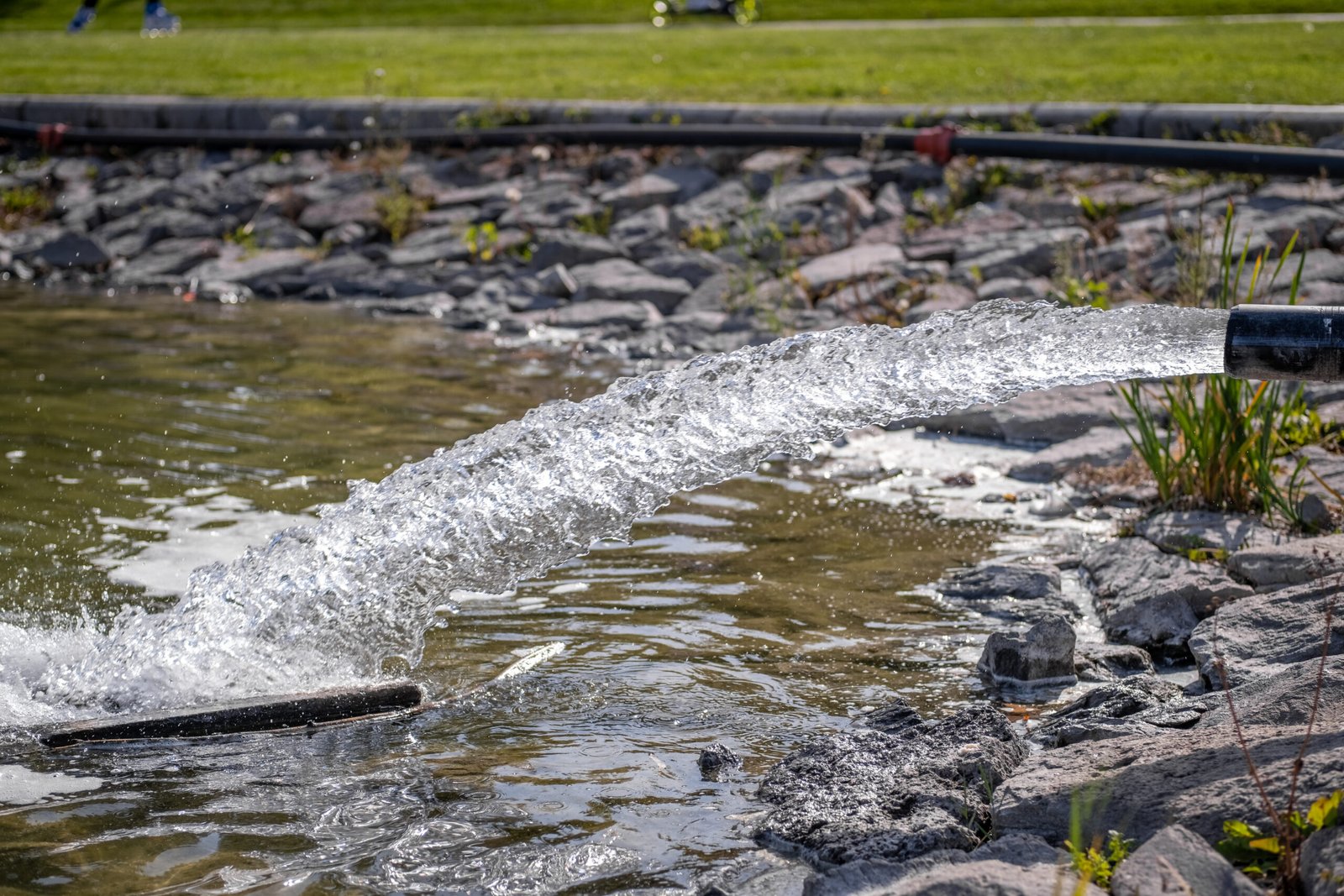
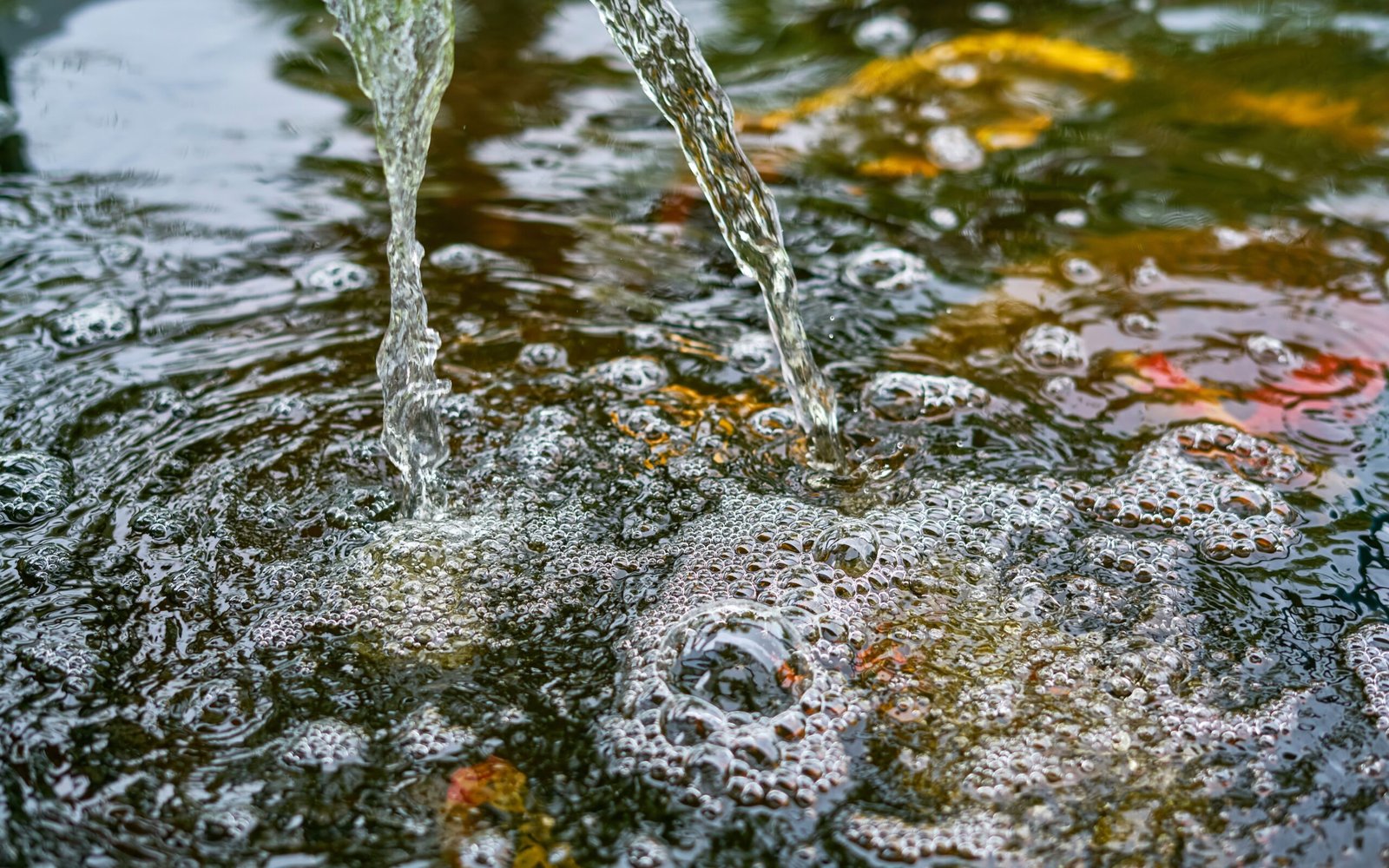
Pond water is foaming

Why is the water in my pond foaming and cloudy?
Q: I understand that good water quality is perhaps the most important way of ensuring healthy Koi, and as such, parameters like ammonia, nitrate and pH should be kept within their recommended levels. But what about other measures of water quality, such as how foamy your water is, or how cloudy it is? Obviously you can’t measure these levels in the same way, but how do you know what is an acceptable level of foam or cloudiness? Is foamy or cloudy water harmful to Koi? What causes it? And how can I prevent it? Are there any sure-fire ways of ensuring crystal-clear water?
A: You are right to put a lot of emphasis behind the key parameters of ammonia, nitrite, pH etc as these will have the greatest influence on the health of your koi. However, I also strongly believe that there are many other factors that can also influence the health and stress-status of our koi. I feel that at times we can focus in on those few key parameters (because we can test for them quite easily) and be guilty of assuming that if they are as desired, our koi should be in tip-top health. If we had the necessary test kits we could test for some of these other factors while perhaps our attention is not drawn to other influential environmental factors as being key parameters because they cannot be identified or quantified by using a test kit (eg ‘foaminess’).
As you suggest in your letter, you are conscious that even with say ammonia and nitrite at ‘zero’, pH stable between 7.5 and 8.5 and nitrates less than 50ppm there’s still room for improvement with regards to your own water quality. You have cited cloudy/foaming water as factors that would not register on a test kit, and yet you’re still concerned about their impact on the health of your koi – (I’m also wary of the other factors that we cannot see or test for). So what about cloudy/foaming water – and its impact on koi health?
What causes cloudiness?
By cloudiness, I assume you mean discolouration or tinting of your water which is till clear, but coloured. This is in contrast to a cloudiness caused by, say, suspended particles (clay, algae etc). In a mud pond, which is widely regarded as being the premier environment for koi, the water is ‘thick’ with a mix of suspended clay particles, silt and algae. These combine to produce a very stable, supportive and mineral-rich environment for koi and yet would be quite out of place in a typical koi pond. So the question as to whether cloudiness is detrimental depends on both the type of cloudiness and the context in which koi are being kept (i.e. in a mud pond or a clear and filtered pond).
Tinged water is caused by an accumulation of dissolved organic compounds that when dissolved in your pond water, absorb and reflect light, changing the appearance of your water. Sometimes in extreme cases, pond water can look like weak tea, but any accumulation, however small, will cause the white koi in your pond to change to an off-white – indicating that you should address the problem (even if your koi appear to be behaving normally).
What Causes Foam on a Pond?
Foam and tea-coloured (tinged) water usually appear together — and for good reason. Both are caused by a build-up of dissolved organic compounds (DOCs) in pond water. When these compounds accumulate, they change the way water behaves, especially when it’s disturbed.
If your pond has a waterfall, venturi, return jet or strong aeration, bubbles will naturally form. In clean water those bubbles burst almost instantly. But in water rich in DOCs, the bubbles become stable and drift across the surface for minutes before finally collapsing. That persistent foam is your early warning sign.
Why DOCs Create Stable Bubbles
DOCs are complex organic molecules that build up gradually through:
-
Koi metabolism and digestion
-
Fish waste and mucus
-
Uneaten or poorly digested food
-
Decaying plant material
-
Algae activity
High-protein diets can accelerate the issue, especially if the food leaches soluble compounds into the water. This increases the organic load and encourages foam formation.
Unlike ammonia and nitrite, DOCs are not processed by nitrifying bacteria. Instead, they are broken down by heterotrophic bacteria — organisms that consume oxygen while digesting organic waste. When DOC levels rise significantly, these bacteria multiply, increasing oxygen demand and sometimes leading to water discolouration and surface foam.
Other Common Causes of Pond Foam
Spawning Activity
During koi spawning, large quantities of eggs and milt (sperm) are released into the water. This sudden injection of protein-rich organic material can quickly generate stable foam, especially around water returns and inlets. In fact, fish farmers often recognise spawning events by the appearance of foam.
Algae Blooms
Excessive algae growth — even if later controlled by a UV clarifier — releases organic compounds into the water. These compounds can contribute to foaming and surface instability.
Pond Treatments and Additives
Certain medications and vitamin-based water conditioners may temporarily increase foaming. This is usually short-lived but can detract from a calm pond surface.
Is Pond Foam Harmful to Koi?
DOC accumulation does not usually pose an immediate, acute threat like ammonia or nitrite. That’s why there are no mainstream test kits specifically for DOC levels.
However, over time elevated DOC can indirectly compromise koi health by:
-
Reducing filter efficiency – Higher organic loading increases heterotrophic bacterial activity, which competes for oxygen and can destabilise biofiltration.
-
Lowering dissolved oxygen capacity – Water can only hold a finite amount of dissolved substances. The more DOC present, the less dissolved oxygen (DO) the water can hold.
-
Increasing long-term stress – Sub-optimal oxygen levels and organic loading can weaken koi resilience and immune function.
In heavily stocked koi ponds, this becomes particularly relevant.
How to Eliminate Pond Foam and Tinged Water
-
Regular Partial Water Changes
The simplest and most effective method is dilution. Replacing 10–20% of pond water regularly reduces DOC concentration and restores clarity. -
Review Feeding Practices
Food is the primary route through which organic compounds enter your pond.
-
Avoid excessively high-protein diets unless temperatures justify it
-
Choose high-quality, well-bound feeds
-
Avoid pre-soaking pellets (this leaches soluble nutrients directly into the water rather than into your koi)
Optimising koi nutrition not only improves growth but also reduces dissolved waste.
-
Install a Protein Skimmer (Foam Fractionator)
If foam is persistent, a protein skimmer offers the most reliable long-term solution. Borrowed from marine systems, pond protein skimmers deliberately generate fine bubbles that attract DOC molecules. The foam produced is collected and removed from the system.
For koi ponds with high stocking levels, this can dramatically improve:
-
Water clarity
-
Surface stability
-
Oxygen availability
-
Overall water quality
In Summary
Foam is not just a cosmetic nuisance — it’s a visible indicator of dissolved organic load. While not immediately dangerous, long-term DOC accumulation can affect oxygen dynamics, filtration performance and koi health.
Regular water changes, sensible feeding and — where necessary — protein skimming will keep your pond clear, stable and healthy.
10 top tips for a crystal clear pond.
A – For particulate matter
1. Dedicate as much filter area as possible to mechanical filtration
2. Make sure all particulate material is free to leave the pond (via bottom drain or pump)
3. Install a surface skimmer as this will a. provide a perfect glass-like water’s surface for viewing and b. intercept particulate matter before it can become waterlogged and sink to the pond bottom.
4. Ensure there is sufficient turnover to remove particulate debris – especially if a UVc is installed.
5. Ensure planted baskets (if you have any) are intact and not losing soil into your pond.
B – For foaming/tinged water
1. Carry out regular partial water changes
2. Install a protein skimmer to prevent accumulation of DOC, removing them as soon as they are released into your pond
3. Recognising that most DOC originates from food, only offer your koi a food containing the appropriate protein content required for that time of year.
4. Do not pre-soak food – it encourages and accelerates leaching
5. Over winter, do not allow leaf matter to accumulate in your pond, as these will breakdown and load your system with DOC.
Equipment for solving foaming/tinged water – How a protein skimmer works.
Protein skimming or foam fractionation capitalises on the dual personality of the dissolved organic molecules and involves creating a fine mass of bubbles, encouraging the DOC molecules to create a stable foam. The foam then naturally rises above the water surface, collecting in a chamber which requires either manual emptying or is fitted with a drain to waste. When a foam fractionator is first installed, phenomenal quantities of foam (and the final brown liquid) are first formed as the DOC molecules are attracted en masse to the air/water interface. Over time, as the DOC concentration drops, so does the rate at which the foam is formed and liquid ‘protein’ removed. When run continuously, once it has cleared the residual problem, it should keep on top of any subsequent DOC accumulation.