Garden Pond Filtration.

Understanding Garden Pond Filtration.
It is a long time since I last watched The Wizard of Oz (I didn’t catch it this Christmas) and I can’t recall the finer details of the ending. But what I do remember is towards its conclusion, experiencing a real anti-climax when we were shown the wizard’s true identity. Instead of marvelling at the amazing actions of a supernatural figure, we see an old man, tucked behind a curtain busily pulling levers and pulleys.
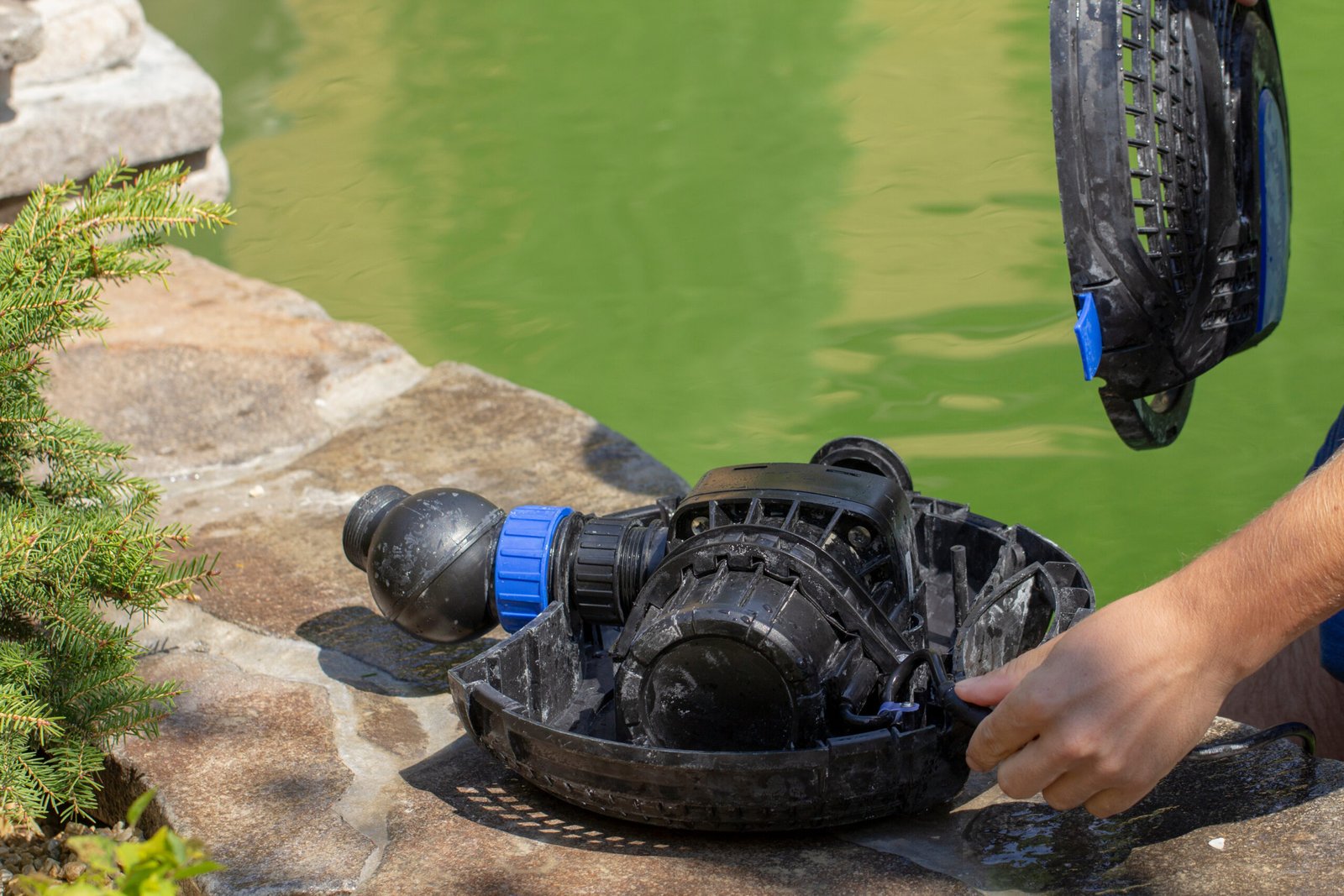
Garden pond filtration is rather similar. Admirers of a beautiful pond are captivated by the tranquillity of cascading water and shoals of colourful fish gliding effortlessly through the depths. Their impression of this serene, perfect world would quickly fade if they were taken behind the curtain to see the levers and pulleys — the unglamorous pipework and filter matting — that make it all possible.
That, in essence, is the role of a pond filter: the ‘backroom boy’ and unsung hero of a thriving pond.
Why Filter?
There are two main reasons for filtering a garden pond:
-
To maintain healthy water quality for fish.
-
To provide clear water so fish can be easily viewed.
These two objectives should not be separated. Both can be achieved through the single process of effective filtration.
Pond fish, like any animal, excrete waste that would be toxic if allowed to accumulate. We understand the link between poor sanitation and disease in human environments and have developed water treatment systems to protect our health. Fish face exactly the same risks when exposed to a build-up of waste in confined water. Installing a pond filter reduces those risks significantly and supports long-term fish health.
Natural vs Artificial
In natural bodies of water such as oceans, rivers and lakes, fish populations exist in balance with their environment. They are so lightly stocked in relation to the vast volume of water that waste does not accumulate to harmful levels. The ecosystem is self-sustaining.
The situation is very different in most garden ponds. These are typically stocked far more densely with fish of various sizes and species, well beyond what would occur naturally. In this artificial environment, waste can build up quickly unless it is actively removed and treated.
Fortunately, effective garden pond filters are readily available and easy to install, with many compact units fitting comfortably in the boot of a car. However, adequate filtration cannot be achieved by relying solely on the small foam pre-filter fitted to a pump’s intake. That component merely protects the pump — it does not provide full mechanical and biological filtration.
How Does a Pond Filter Work?
A garden pond filter performs two complementary functions:
-
Solids removal (mechanical filtration)
-
Biological filtration
Function 1 – Solids Removal
The first role of a filter is to remove solid matter pumped from the pond. This may range from fallen leaves and fish waste to fine particles that make the water appear slightly cloudy.
Solids must be removed before the biological stage can function effectively. If debris is allowed to pass through unchecked, it can clog biological media and reduce overall filter performance.
Mechanical filtration is often the limiting factor in a pond filter’s efficiency. A significant proportion of filter space should be dedicated to solids removal because debris can accumulate quickly — particularly when a UV clarifier is installed, as it causes algae to clump together.
In standard external “black box” biofilters, mechanical filtration works through entrapment. Water passes through two or three grades of foam, arranged from coarse to fine. The coarser foam traps larger particles first, while finer grades capture progressively smaller debris. This staged approach works much like a sieve.
Many submersible pumps are fitted with foam or perforated plastic guards to prevent large debris from damaging the impeller. While useful, these guards do not replace proper filtration. In fact, they can prevent larger debris from reaching the filter, allowing it instead to remain in the pond where it may contribute to cloudiness or sediment build-up.
Clear Isn’t Always Healthy
It is important to remember that clear water does not automatically mean healthy water.
Mechanical filtration improves clarity, largely for aesthetic reasons. Interestingly, pond fish often tolerate — and may even prefer — slightly turbid water similar to that found in natural clay-bottomed ponds.
However, the real threats to fish health are invisible. Ammonia and nitrite are soluble, colourless compounds that cannot be detected by sight, yet are highly toxic. These substances are broken down into less harmful forms through the process of biological filtration.
Healthy water is therefore about chemistry, not just appearance.
Function 2 – Bio-filtration
Having safely removed any solids from the pond water, the clear water now passes through the part of the filter specifically designed for bio-filtration. As its name describes, a bio-filter is a living filter, colonised by many millions of bacteria whose role is to consume and breakdown the toxic ammonia that is constantly being excreted by fish (and other aquatic organisms).
These beneficial bacteria will colonise any hard surfaces (including the pond liner, pipework and rockwork making them feel slippery and slimy). However, a bio-filter is designed to provide a vast surface area on which these bacteria can colonise, providing the surface area in a filter which may naturally be found in many square metres of a natural pond or lake bottom.
Keeping a filter alive.
These well-housed bacteria are provided with a luxury lifestyle, receiving all their requirements for a long and healthy life. The steady turnover of water through the filter provides a constant source of ‘food’ – in the form of ammonia, as well as an essential supply of dissolved oxygen. It is recommended that the pond volume is turned over at least once every 2 hours.
As this vital part of filtration is ‘living’, unlike mechanical filtration, the bacterial colony takes time to become established or ‘mature’ and a filter must be run-in gently over the first months of its life. Fish should be added a few at a time, so that the bacteria can adjust and catch up with the rate of ammonia being produced by the fish. If too many fish are added too quickly, then ammonia levels will rise rapidly, causing fish stress and ultimately leading to disease.
Watch out for nitrite as well as ammonia!
Aerobic (oxygen-loving) bacteria breakdown the toxic ammonia into nitrite, which unfortunately, is still toxic. In fact, nitrite has a nasty habit of being more difficult to break down than ammonia and will persist longer than ammonia in water that is suffering a quality problem.
Care of the filter
Filters must be treated like a living entity. If they are not provided with oxygen, water and food, they will deteriorate and die. For this reason, a bio-filter must be run continuously, ensuring that the bacteria are provided with the materials for life.
There are times, as with any filter, that it must be cleaned and maintained. In the summer especially, waste will build up rapidly within foams, and these should be cleaned out before they clog or restrict the filter. This can be done without disturbing the more sensitive bio-filter.
In a box filter, where the foam layers may act as both mechanical and biological media, care must be taken when rinsing out the foams.
Bacteria are very sensitive to changes in their environment and any adverse action could set the filter’s maturity and efficiency back months. For this reason, when rinsing out the foams or cleaning any biological media, buckets of pond water should be used. If raw tap water is used, then chlorine and other variations in the water quality can have a detrimental effect on the bacteria.