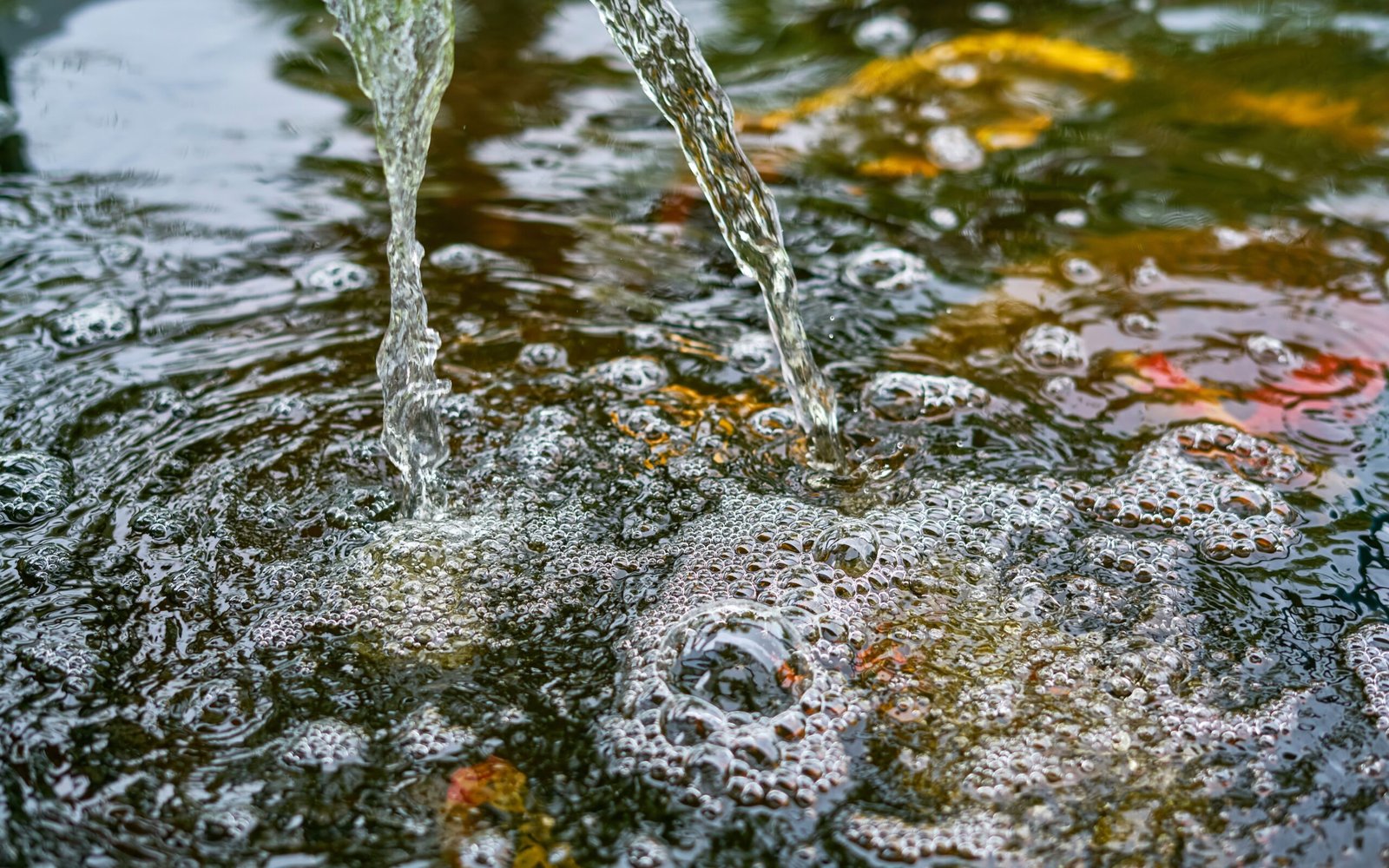
Pond water changes

How to perform successful partial pond water changes
Water management is the key to success in koi keeping. If we can understand the principles involved and how our actions may cause, prevent or avert problems then it should be possible to produce a balanced pond environment supporting a collection of healthy, vibrant and growing koi.
There are essentially 4 different phases to a cycle of water management, each of which can have a profound effect on water quality. The fourth and final phase involves a water change.
Phase 1. Source and quality of water for the pond.
This will determine the base line for the pond’s quality from which, if required, we can manipulate the water’s characteristics. The vast majority of us choose (or are rather limited to choosing) tapwater as the starting point for our pond. Our tapwater will bring with it a specific pH, hardness and mineral content and determine what actions we may need to take to make the water more stable for koi. This may involve putting our tapwater through a series of water purifying units or simply adjust the wider mineral content through the addition of clays or calcium based products. In either case, care should be taken that a tap water conditioner is added to any new water. Whatever actions we choose to take with our source water at this first stage of preparing a pond for koi, we will set the standard for the rest of the pond’s life.
Phase 2. Additions to the pond.
The addition of many things to a pond (whether intentional or not) will interact with the water, altering its characteristics. These can be acute interactions where water quality will change rapidly, or more long term chronic changes where the pond’s characteristics may change undetected and by stealth.
Acute changes. Chemical treatments such as Formalin and malachite, acriflavine or salt, and the addition of food will cause an increase in the concentration of solutes in the pond, changing its characteristics from the ‘norm’ very quickly.
Chronic Changes. The leaching of pollutants from inferior plastic, fibreglass or metal products, the steady build up of phosphates, nitrates, sulphates etc as by-products of feeding and filtration and the accumulation of the multitude of other inorganic and organic compounds introduced through koi metabolism and excretion can all lead to subtle changes to water quality.
Care must be taken to monitor and detect either chronic or acute changes to the pond’s quality in order to maintain a stable, quality environment.
Phase 3. Filtration.
In some respects, filtration is an inaccurate term to use when describing the detoxifying process of a ‘filter’ as dissolved impurities are not removed (as the term may suggest) but are in effect reprocessed or altered into less toxic compounds.
For example, when ammonia is ‘filtered’ it is not actually physically removed from the water, but is reprocessed into nitrite and then nitrate. In other words, its appearance is disguised, being processed into the form of other products which none-the-less, continue to accumulate in the pond water.
In many respects, we are encouraged to focus on (and rightly so) the nitrogenous compounds in the water (ammonia, nitrite and nitrate), monitoring their safe passage through their various forms until they are dumped into the nitrate bank. However, similar reprocessing activities carried out by other bacteria are also taking place with other element groups such as phosphates, sulphates, etc until, just like the nitrates, are dumped to accumulate in their relative bank or ‘sink’. – causing their levels to rise.
In summary, the filter performs many important detoxifying and reprocessing functions, which in a natural water body would lead on to other biological processes. However, within the limits of a koi pond, there is little scope for similar biological processes to occur requiring another process to relieve the pressure of the accumulation of the reprocessed waste.
Phase 4. The water change
In a natural water body, a combination of biological and meteorological processes would prevent the build up of soluble waste products maintaining a healthy and balanced ecosystem. As this is not the case in a koi pond, the solution to the build up of pollution has to be dilution.
A partial water change does not simply act to maintain a stable water quality, it also completes the cycle, taking it back to Phase 1, recognising that the quality and quantity of the water used in a water change will ultimately affect the rest of the pond’s characteristics.
The diluting effects of a water change are necessary to maintain a healthy pond, – but there are a number of considerations to take when determining your water changing strategy.
Sources of water:
The most reliable source of water is of course tap water. For many koi keepers it is the bane of their lives and the first and greatest obstacle to keeping koi. It’s quality and suitability varies throughout the country and even within regions, can vary throughout the year as water companies source their supplies from various reservoirs, rivers and aquifers. Nevertheless, it is always available in the quantities required and at a standard quality.
Many koi keepers are able to top up their ponds in the confidence that for the majority of time their tap water has ideal parameters for koi (hard, alkaline, and well buffered),while others must add water improvers (such as a ready source of calcium carbonate or even sodium bicarbonate in extreme cases), as a matter of course, depending on their location.
I know of a couple of koi keepers who are completely self-sufficient with their topping up water, relying on rainwater for their supply. But this too can have its risks, as its quality and consistency can be very variable.
A product of where it’s been.
I remember, as a teenager, often faced with the opportunity of experiencing a ‘night out’ for the first time, often attending without my mum’s permission. My difficulty arose when returning home, (at a reasonable hour – of course!) and being confronted by mother, who, the instant she smelt my clothes, knew that I’d been to a disco or party without her permission. It was not worth my while denying it as I had picked up the smell of cigarette smoke on my clothes, as evidence of where I’d been.
Water acts in a very similar way, adopting the ‘tastes and flavours’ of where it has been along its journey.
Whenever water passes through or over surfaces that contain soluble substances, the water will start to express similar characteristics to the substance. As rain water drops through the sky, over roof tiles and along guttering, it will pick up impurities which will alter its chemistry.
Due to the unpredictable nature of our atmosphere and what it contains (and our roof material and low quality guttering (non-food grade plastic)we cannot be sure of its quality, (or its quantity and availability). Furthermore, unlike tapwater, it does not have to conform to an industry standard and is likely to be very acidic and have a negligible kH, both undesirable features for a koi pond.
Top up or water change? – What’s the Difference?
When we are fortunate enough to experience warm weather, we soon notice the level of our ponds begin to drop through evaporation. In the summer months, a pond can drop by a few inches each week, especially if the system incorporates a run of open and flowing water. The obvious action to take in response is to top up manually through the hose pipe and be comforted by the fact that the pond has been ‘freshened up’ by the addition of new water.
However, over a long period of time, where lost water is replaced by new water, rather than see an improvement in water quality, the reverse is likely to happen. When water evaporates and leaves the pond, it leaves any solutes behind, increasing the concentration of solutes in the pond. When additional water is added (complete with more solutes), the composition of the pond water will slowly deteriorate due to the build up of additional unwanted compounds.
To avoid this, water should be regularly removed from the pond, carrying with it a concentration of solutes (nitrates, phosphates, salts etc.) that will have accumulated. This will both ‘freshen up’ the tired pond water and reduce the concentration of the remaining solutes.
A pond should be designed with regular water changes in mind. The easier they are to carry out, the more likely we will carry them out and the better our koi’s health is likely to be.
Good design will allow gravity to take it away to the drain, combining a purge of a vortex or settlement chamber with an opportunity to dump some tired water. As only the tiny minority of koi keepers can afford a motorised valve fitted to a weekly timer switch, this usually involves the manual opening of a slide valve on the bottom of the filter chamber.
Auto top-up or manual?
If you have had the opportunity to incorporate subterranean pipework for your pond and your filters are below ground, then you have an ideal opportunity to include an automatic top-up. Borrowing the technology from a W.C. cistern, a ball valve assembly can be simply attached to the inside wall of a filter chamber, concealed from view and on stand-by 24 hours a day. Such a system keeps on top of any evaporation or losses through splashing but as mentioned earlier, must not replace a regular dumping of water from the pond.
How regularly?
The objective of carrying out a water change is to provide koi with as good and stable a water quality as is possible.
The stability of the pond’s quality can be maintained during a water change by ensuring that;
a). New water is not too dissimilar to the pond water.
b). The volumes of water changed are not excessive.
c). Fish are prevented from experiencing an excessively large drop in water temperature.
An effective water changing strategy that satisfies all factors is one based on “a little and often”. The precise positioning of a stand-pipe or an overflow installed just below the water level in a filter wall to drain coupled with an auto top-up can ensure that a steady trickle of fresh water is maintained through the system. (Figure 2) Such a method assumes that the mains water quality will continue to be satisfactory but to guard against any negative fluctuations, it would be wise to install an in-line water purifier.
If you do not have the facility for incorporating an overflow then try to remove an average 10-20% of your pond water each fortnight during the warmer months when food is being offered on a regular basis. This will complete Phase 4 of managing a stable water quality and ensure your koi will experience a healthy water quality.