Koi Pond Filtration

Koi Pond Filtration – and how to manage it.
The most appealing part of koi keeping is marvelling at a pond full of ornamental beauty. The challenge in achieving that ultimate goal is to be able to understand and master the many practical demands put on a koi keeper. Some of these practical challenges, on the face of it, may appear far removed from successful koi keeping, but in fact are a key part to success. Understanding and implementing the art and science of filtration is one such challenge.
We should make it our responsibility to understand the theoretical and practical aspects of filtration as this will help us to design or fine tune our own filter. At its extreme, such knowledge will range from the chemistry, physics and biology of water through to the implications of flow rates and solvent-welded pipe joints.
Fortunately, there are a number of basic principles which whatever the filter system we may choose or however detailed we wish our knowledge of filtration to be, will always keep us in control of our filter and in command of our water quality and fish health.
Why filter?
There are two motives for filtering a koi pond.
1. To achieve a healthy water quality to maintain koi health.
2. To provide clear water in which koi can easily be viewed.
These two objectives should be taken as a whole as they can both be achieved through the single process of filtration.
Koi are just like any other animal in that they excrete waste which if allowed to accumulate in their body would be toxic. For many centuries, man has recognised the link between poor sanitation and disease and has invented practical water treatment solutions to reduce the risk to human health. Fish will experience exactly the same threats to a healthy life if they are also exposed to a build up of toxic waste and this problem can also be solved by installing an appropriate filter system.
Natural vs Artificial.
In natural balanced water bodies, such as oceans, rivers or lakes, fish are in balance with their environment. They are so lightly socked in relation to the water volume that there is sufficient natural food on which to feed and there is no build up of fish waste. Their natural aquatic environment is self- sustaining. This is not true in most koi ponds. Koi ponds are typically well stocked with koi in all varieties and sizes, well above the stocking levels that would be found naturally. Consequently koi require artificial food to sustain them (as the pond will not provide sufficient naturally), and in a similar way, there is insufficient natural bacterial action in a typical koi pond to breakdown the waste produced. Put simply: No filter – no fish.
How does a pond filter work?
Koi pond filtration can be broken down into essentially 4 different yet complimentary functions:
1. Solids removal
2. Biological Filtration
3. Chemical Filtration
4. Sterilisation
Function 1- Solids Removal
A filter’s first function is to remove solid matter suspended in the water. This could vary in size from fallen leaf matter down to microscopic particles that may make the water slightly cloudy. Solids are removed first to reduce clogging of subsequent filter chambers thereby enhancing the overall filter efficiency.
Traditionally, mechanical filtration is likely to be the most limiting part of a pond filter. Most filter space should be designated for solids removal as debris will soon collect and then pass through to the other chambers. Furthermore, a larger chamber can tolerate less frequent cleaning, which should be carried out when significant waste has been collected. Solids can be removed in a number of ways, depending on the size and design of the filter.
1). Settlement. This is probably the simplest form of primary filtration and involves reducing the flow rate of water in the first chamber. If the speed of water flow is reduced, then its ability to hold solids in suspension is also reduced, causing the solids to settle out of suspension. This method of removing solids is used in larger, multi-chambered filter systems, where the pipework removing dirty water from the pond opens out into a vast settlement chamber. Compared with the relatively fast flow rate of water through the pipework leading from the bottom drain, the water in the first chamber slows down so much that solids drop out of suspension. In many such systems the first settlement chamber feeds through to a second settlement chamber through “up and over” weir boards, slowing the flow down even more, helping to settle out the finer solid material.
2). Vortex. A vortex takes settlement a stage further by using a number of different flow characteristics to allow debris to settle. A large conical chamber will receive water from the pond in a fashion which causes the water to ‘spin’ within the chamber. The water leaves the chamber through a surface drain position centrally, passing into the next chamber. The spinning action and changes in direction experienced by the water causes solid matter to settle out on the bottom of the chamber.
A vortex is like settlement in that it is better fed by gravity through a bottom drain rather than pumped water. If a pump is used to feed dirty water from a pond to a filter then entrapment is a better option for mechanical filtration.
4). Entrapment. This is the method used in standard external black box biofilters, where 2-3 grades of foam, running from coarse through to fine act to trap solids as they pass. Acting in a similar way to a sieve, the first filter media that the pumped dirty water encounters is quite coarse in structure, trapping and removing suspended solids from the water.
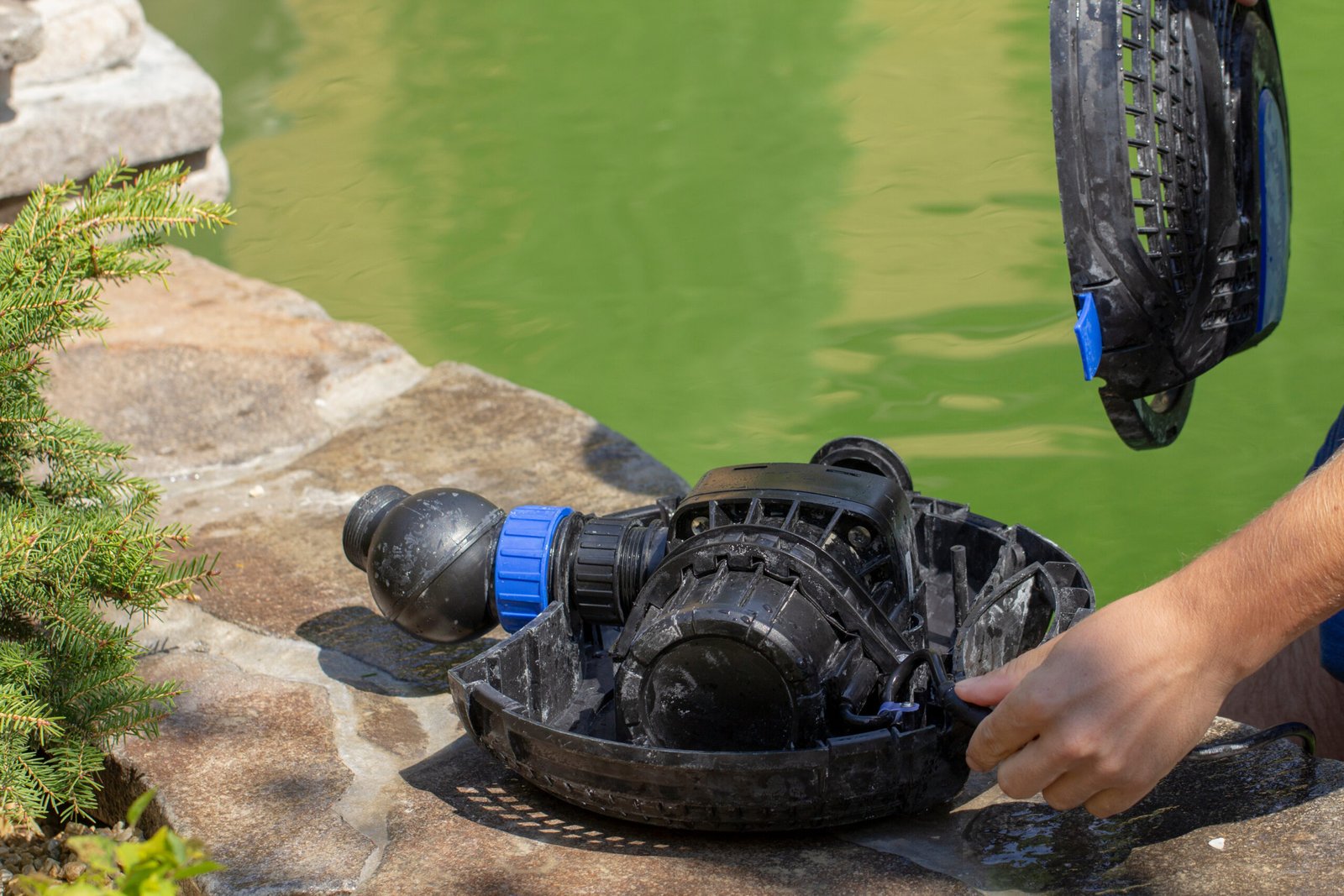
Unfortunately, submersible pumps are usually fitted with a foam or perforated plastic guard to prevent debris from choking the impellor. This can prevent leaves and other larger solid particles from reaching the filter, being retained in the pond, causing the water to cloud or silt to build up on the pond bottom.
More recently, pumps specifically engineered to handle solids have become available which can overcome this problem. However, such pumps can have a tendency to ‘liquidize’ larger particles into finer material, making it harder to remove them in a filter.
5.) Sand Pressure Filter. An external sand pressure filter can be used to remove solids from a koi pond. Adopted from swimming pool filtration, sand pressure filtration will remove even the finest particles. However, they can prove to be too efficient, requiring regular backwashing. A powerful external swimming pool pump will also be required to operate them.
Clear isn’t always healthy.
Just because water is clear doesn’t mean that it is healthy. Solids are removed largely for aesthetic reasons, as koi actually prefer the turbid waters of a clay pond. The real koi killers are ammonia and nitrite which are soluble, colourless and undetectable to the eye. But if the pond water is filtered continuously through a bio-filter, then it is very likely to be healthy, and this is the second function of filtration.
Function 2 – Bio-filtration
Having safely removed any solids from the pond water, the clear water is now passed through the part of the filter specifically designed for bio-filtration. As its name describes, a bio-filter is a living filter, colonised by many millions of bacteria whose role is to consume and breakdown the toxic ammonia that is constantly being excreted by koi (and other aquatic organisms).
These beneficial bacteria will colonise any hard surfaces (including the pond liner, pipework and rockwork making them feel slippery and slimy). However, a bio-filter is designed to provide a vast surface area on which these bacteria can colonise, providing the surface area in a filter which may naturally be found in many square metres of a natural pond or lake bottom.
Function 3 – Chemical Filtration
Chemical filtration is quite rare in koi ponds and to some extent is regarded as an optional extra, but this will ultimately depend on specific circumstances. Chemical filtration will use a number of different methods to remove specific undesirable compounds or groups of compounds from pond water.
Zeolite.
Zeolite is probably the most widely used form of chemical filtration in koi ponds. It is used in emergencies to remove ammonia during an ammonia peak. Zeolite is a porous, clay-based mineral which chemically adsorbs ammonia in exchange for sodium ions which are released into the pond water. It can be recharged once exhausted, by soaking it in salt water. It should really only be used short term as it can remove pond treatments from the water which is undesirable. And why not simply carry out an emergency partial water change when experiencing an ammonia crisis?
Protein Skimmers
This is one of the latest filtration innovations for koi ponds and adapts the process of protein skimming that has been used routinely in marine aquaria for many years.
What is Protein Skimming?
Protein skimming is the action by which proteins (and many other soluble pollutants) can be removed from the pond water. Some of these soluble compounds can cause the water to discolour or froth, with their removal reducing these unsightly phenomena. Protein skimming also assists the bio-filtration process by physically removing compounds which would otherwise be processed by a biofilter.
The undesirable soluble contaminants are irresistibly attracted to the bubble surfaces, forming a foam which builds and collects in the skimmer ready to be removed. The more foam that is produced and collected the greater the amount of soluble contaminant removed, reducing the workload of the filter.
This ingenious piece of pond equipment is not a necessity but can provide additional benefits to the operation of filtration in the provision of good water quality.
Function 4 – Sterilisation
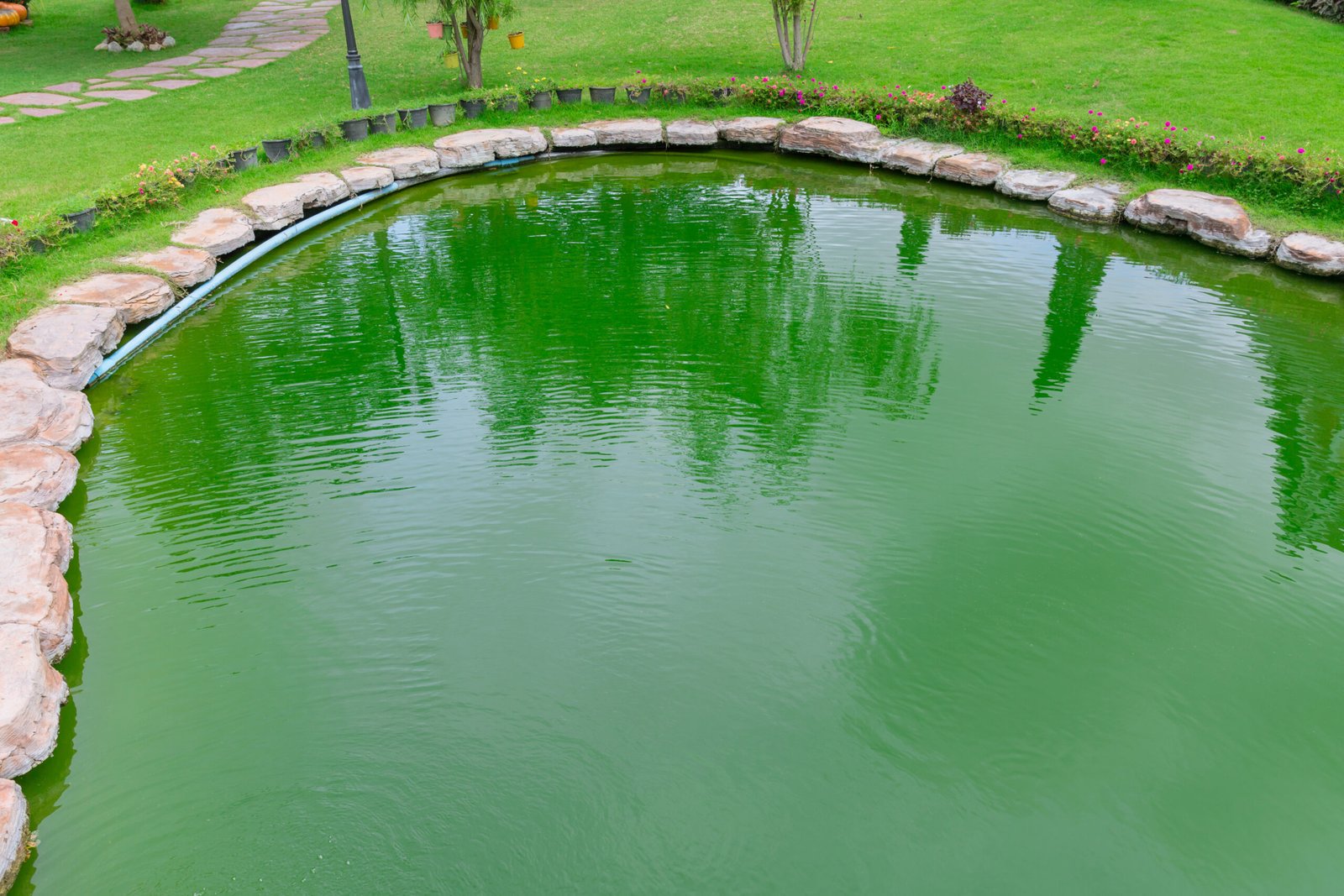
Pond filters will remove solids and detoxify the water, but they will not reliably clear green water. The microscopic algae cells that bloom in pond water to create green water are far too fine to settle or be filtered out mechanically. A guaranteed method of clearing green water is to install an ultraviolet clarifier (UVC) between a pump and the filter. The radiation emitted by the UVC causes the microscopic algal cells to clump together in green sticky ‘flocks’, which are of a suitable size to be removed mechanically by a filter. UV’s consistently produce significant quantities of solid matter which can push the solids removal part of a filter to its limit. It is useful if using a UVC to opt for an oversized filter with a large area for mechanical action that will cope with the excess solid waste.
Care of the filter
Filters must be treated like a living entity. If they are not provided with oxygen, and food, they will deteriorate and die. For this reason, a bio-filter must be run continuously, ensuring that the bacteria are provided with the materials for life.
There are times, as with any filter, that it must be cleaned and maintained. In the summer especially, waste will build up rapidly in a settlement chamber or within foams, and these must be cleaned out before they clog or restrict the filter too much. This can be done without disturbing the more sensitive bio-filter.
If cleaning out a filter chamber, the action of simply opening a valve may be sufficient to purge the chamber. In a box filter, where the foam layers may act as both mechanical and biological media, care must be taken when rinsing out the foams.
Bacteria are very sensitive to changes in their environment and any adverse action could set the filter’s maturity and efficiency back months. For this reason, when rinsing out the foams or cleaning any biological media, buckets of pond water should be used. If raw tap water is used, then chlorine and other variations in the water quality can have a detrimental effect on the bacteria.