Choosing pond heaters

How to choose the right pond heater.
Compared to other pond hardware such as must-have items such as a pump and filter, a pond heater is an optional purchase (depending on your budget and your approach to koi keeping).
Why consider buying a pond heater?
Better for your koi? Our cold-blooded koi have no choice but to respond directly to the temperature of their pond. So naturally, during the colder months, when water temperatures fall below 8C, koi become lethargic and stop feeding until the spring weather warms your pond up again. Heating you pond will mean your koi will be active all through the winter months. A heater can also remove some of the heartache over winter, allowing us to control our pond environment, reducing the extremities and duration of an inhospitable winter. It will also enable us to interact with our koi for longer each year.
Heating strategy.
Koi keepers and koi professionals that choose to heat their ponds over winter (many still do not) will differ in their approach in how they use the heater.
a. An artificial summer, 24/7. The pond is heated to summer temperatures (18C) when ambient is insufficient to sustain a warm temperature.
b. Remove harsh extremities. A thermostatically controlled heater is used to prevent koi from experiencing a prolonged, harsh winter, setting it at 10C
c. Controlled natural winter. For those koi enthusiasts who believe (and I am one of them) that koi not only require but benefit from a winter period, then a pond heater can be used to reduce the length of a natural cold period, setting it to heat the pond for all the winter barring a 4 week period of natural ambient winter temperature.
Assuming you have one of the above 3 strategies in mind for your own koi, you will need a means of heating your pond. Inevitably, there are cost implications, installation issues and various options of how to heat your pond. Once we have explored the options, you will be in a position to decide whether such a project is achievable and affordable – and whether you consider the benefits outweigh the costs.
The options:
Option 1 – Electric Heating
Electric heating is the most straightforward method of heating a pond. It heats the pond water directly and efficiently, making installation relatively simple.
For many years, standard swimming pool heaters were adapted for use in koi ponds. These units remain widely available and are offered in a range of sizes to suit different pond volumes. However, dedicated koi pond heaters are now manufactured using chemically stable materials such as titanium, which offer exceptional resistance to corrosion and chemical attack. The associated casing and pipework are also designed to withstand the specific conditions found in pond systems.
Selecting an electric pond heater follows similar principles to choosing a UV clarifier (UVc) — the unit must be matched to the pond’s total volume. Installation is also similar, typically involving integration into the filtration return line.
Electric heating is considered efficient because it transfers a high proportion of the energy consumed directly into the water. However, efficiency does not automatically mean low running costs. Ongoing expense depends largely on the unit cost per kilowatt-hour of electricity, which can make electric heating comparatively expensive in some regions.
Option 2 – Heat Exchanger with Boiler Supply
Heating a pond via a gas boiler and heat exchanger is an indirect method and technically less efficient in terms of energy transfer. However, because gas is often cheaper than electricity, it can prove more economical in long-term running costs.
The initial capital outlay is significantly higher than for electric heating. More equipment is required, and installation is more complex. This is rarely a DIY project. A qualified gas engineer must connect the boiler safely to the gas supply.
Unlike an electric system, which operates on a single pumped circuit, a boiler-based system typically involves two separate circuits:
-
A hot water circuit running between the boiler and the heat exchanger.
-
A pond water circuit running between the heat exchanger and the pond.
These two circuits are completely independent and must never mix.
How a Heat Exchanger Works
Hot water from the boiler flows into one side of the heat exchanger. Inside the exchanger, the hot water passes across a large surface area designed to maximise heat transfer. On the opposite side, colder pond water flows in the opposite direction (counter-flow).
Heat transfers through the exchanger walls, warming the pond water without the two water sources coming into contact. The cooled boiler water then returns to the boiler to be reheated, while the warmed pond water flows back into the pond.
Sizing the System
Correct sizing is essential for effective heating.
The heat exchanger must be matched to both the pond volume and the water turnover rate. For example, a 2,000-gallon pond typically requires a turnover of around 1,000 gallons per hour. This may suit a heat exchanger rated at approximately 70,000 BTU.
The boiler must be capable of supplying at least this level of heat output. If a gross output of 70,000 BTU is required, then the boiler must meet or exceed that rating.
However, some boilers are rated by input rather than output. In such cases, it is important to account for efficiency. As a rule of thumb, assume around 80% efficiency. Therefore, if you require 70,000 BTU of usable output, you would select a boiler with an input rating of approximately 90,000 BTU.
Careful calculation at this stage ensures that the system performs reliably and maintains stable pond temperatures throughout the colder months.
How is heat output of a boiler or heat exchanger measured?
The power output capacity of a heat exchanger will be described in BTUs (British Thermal Units) which in turn will be related to a recommended flow rate of pond water through the unit.. At the top end of koi pond heat exchangers, 460,000 BTU will take a flow rate of 4600 gallons, suiting a pond up to 10,000 gallons. Pond water will be pumped through one channel of the heat exchanger continuously (just as it would do through a UVC).
Questions you should ask when considering a heating system.
a. What size of heater do I need? This will be based on the volume of your pond. The heating capacity of an electric heater is measured using their power consumption – in Kilowatts. A heat exchanger is measured in BTUs (British Thermal Units)
b. How easy is it to install? This will depend largely upon your existing pump and filter set-up. It is arguably easier to install an in-line electric heater in a pump-fed system (due to the likelihood of there being exposed and accessible pipework). If you have installed a separate UVc, then you will have the skills to plumb in an inline heater. Check which additional pipe fittings you will need. For a heat exchanger, you will need to consider where you are going to position it – and where your supply of hot water will come from and the route it will take to your pond. You may need to invest in an additional boiler.
c. What about the installation?
• Electric Heater: You may have read about the new legislation relating to new electrical installations. As of 1st January 2005, new electrical installations, including those in gardens now come under Building Regulations. This means that to comply with your local authority’s building control, for any new circuits (replacement sockets do not count) you will need to notify building control. If your heater is less than 3Kw, then the existing electrical feed is likely to be sufficient. For heaters >3Kw, you will need to install a new electric feed, directly from your home’s consumer unit / fuse box. If you are anything like me, you will be reaching for your yellow pages to find a qualified electrician to do the job. A ‘competent person’ registered with Part P of the building regulations (holding EAS certificates) will be able to issue you with a Building regulations Certificate of Compliance – freeing you of the regulatory burden.
• Heat Exchanger / boiler. If you are confident with your hot water plumbing skills, then you can install a heat exchanger yourself. However, if you need a new boiler, you will need to employ the services of a CORGI registered gas installer.
d. Heat control.
– Thermostat. This is essential for giving you control over the temperature of your pond. Look out for the sensitivity of the thermostat (i.e. at what increments it can be set to turn on and off). Also check to see how easy it is to read and set. Is it a dial or is there a digital read out?
– Timer. Some electric heaters are available with a timer. However, a thermostat should be sufficient to maintain the required temperature – making a timer of little use.
e. Construction and Durability.
How will you house the heater or heat exchanger? Can the model be left open to the elements? What materials is the model made from? Are these safe and inert and therefore suitable for koi? Don’t assume that swimming pool heaters are safe to use in a koi pond. What guarantee come with the unit? Is that competitive? What are the terms of the guarantee? i.e. what will happen in the event of a breakdown, which in most cases will be an emergency?
f. Cost.
What is the likely cost of the unit, its installation and running costs?
– Calculating the running costs are easier for an electric heater. The running costs will be a function of the cost of electricity (measure in Kwh) and the duration that the heater is on. This period will be governed by the thermostat setting in relation to ambient temperature.
For example: For a 2000 gallon pond, running a 2Kw electric heater over the 4 months from November to February. Assuming that the heater will be working 18 hours each day (this will vary depending on the temperature required) and that 1Kwh costs 10p:
120 days x 18 hours = 2160 hours
2160hours x 2Kw = 4320 Kwh
4320 Kwh x 10p/Kwh =£432
Maintenance:
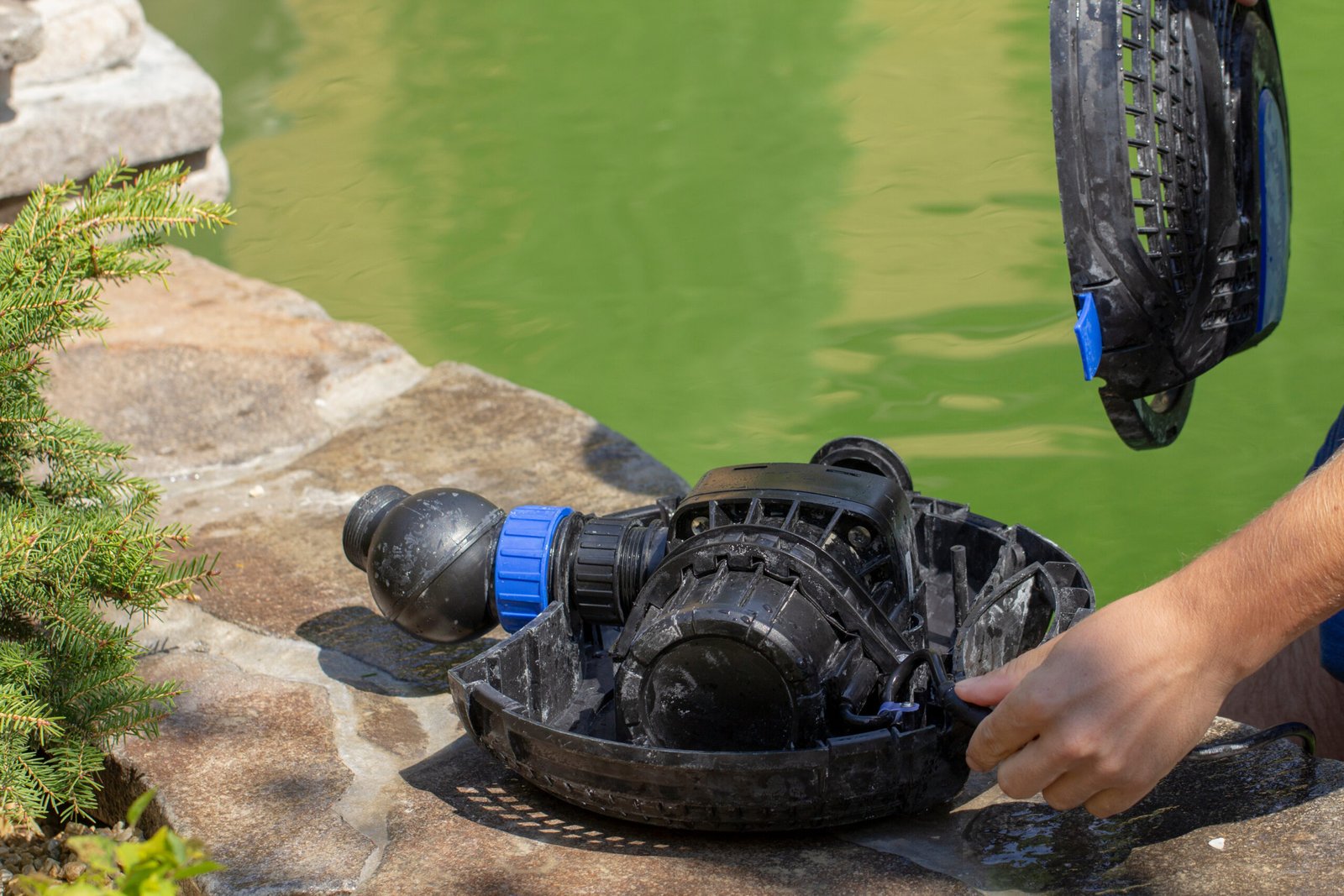
Inevitably, where water comes into contact with extreme heat and in an area of restricted flow, solids will tend to accumulate around the internal surfaces of a heat exchanger or heater. They should be plumbed in with easily removable couplings so the units can be serviced and rinsed out. Depending on the type of heat exchanger, some can be completely stripped down.
Things you need to know about your own pond when researching pond heating options.
1. Volume
2. Existing pipe diameters (for matching up pipe-fittings)
3. Proximity and route to suitable electricity supply or hot water supply.
The Costs for a 2000 gallon pond.
Gas-fired Boiler Option* Electric Heater Option
1. Hardware:
Boiler £600 2Kw heater £300
Heat Exchanger £170
2. Installation
Corgi Installer £300
Plumbing + Elec Labour, Plumbing + Electrical
Sundries £300 Sundries £300
Subtotal £1370 Subtotal £600
*Assuming it will be installed in an existing outhouse or garage.
3. Running Costs
It’s not possible to calculate or even estimate these as it depends on the heating strategy employed and the external / ambient temperatures.
Top features to look for when choosing a heating system.
1. Heat output
2. Level of control
3. Relative running costs
4. Purchase can installation costs
5. Safety and reliability.