Upgrading pond filtration

Filtration: Upgrading from pond keeper to koi keeper
Mechanical Filtration.
Mechanical Filtration in Your New Koi Pond
Mechanical filtration serves two essential purposes in a koi pond.
1. Clear Water
Mechanical filtration is the first stage of filtration and is often referred to as primary filtration. Its job is to remove suspended debris by trapping or settling particulate matter.
This process is largely aesthetic — allowing you to clearly view your prized koi. Interestingly, koi do not require crystal-clear water and often thrive in the naturally turbid conditions of traditional mud ponds.
2. Protecting the Biological Filter
Even a modest filtration system will process thousands of gallons of water each day. Mechanical filtration prevents solid waste from accumulating within the biological media.
If silt and sediment are allowed to clog the fine structure of the biomedia, water flow becomes restricted, oxygen levels drop, and bacterial efficiency declines. This can lead to the accumulation of toxic ammonia and nitrite, directly affecting koi health.
Keeping biological media clean and free from blockage ensures that a dense population of beneficial bacteria can colonise and function effectively.
Methods of Removing Suspended Solids
There are two primary approaches to mechanical filtration.
1. Settlement and Vortex Systems
These are used in gravity-fed systems and rely on slowing water movement to allow suspended solids to settle out naturally. As water velocity decreases, its ability to hold solids in suspension reduces, allowing debris to sink.
2. Entrapment
Entrapment is commonly used in pump-fed systems. Water passes through filter media — such as foam, brushes, or micromesh screens — that physically trap debris.
More advanced pump-fed systems may use self-cleaning micromesh screens, such as those found in systems like “The Answer.”
Making Settlement Chambers Work Effectively
If you choose gravity-fed filtration, you must understand how to optimise settlement.
Effective settlement begins before debris even reaches the chamber. Particles must remain as large as possible while in the pond, since larger particles settle more easily. This is best achieved using a bottom drain.
A gravity-fed settlement chamber supplied by a passive bottom drain gently transfers solids without breaking them up. In contrast, a pump-fed system can macerate solids into finer particles that are much harder to settle. Pumps also energise the water, whereas settlement requires slow, calm flow.
For this reason, settlement is ideal for gravity-fed systems, while entrapment is preferred for pump-fed systems.
If you plan to use settlement chambers, you must also plan for a bottom drain installation — which involves additional groundwork and expense.
Designing Effective Settlement Chambers
The key principle in settlement design is simple: slow the water down.
a. Wide Pipework
Use 4-inch pipework between the pond and settlement chambers. Larger pipe diameter prevents “jetting” and encourages slow, laminar flow.
b. Large Chamber Volume
A settlement chamber can be too small — but rarely too large. Incorporating at least two chambers is recommended.
As a minimum guideline, consider chambers approximately:
-
30 inches wide
-
3 feet deep
-
3 feet long
Larger chambers further slow incoming water and improve sediment drop-out.
c. Baffles or Weir Boards
Up-and-over boards force water to change direction between chambers. Each directional change slows flow further and encourages additional debris to settle.
d. Drains to Waste
Floor drains in each chamber allow easy purging of accumulated waste. A standpipe and weir arrangement enables each chamber to be flushed independently, allowing rapid cleaning and quick resumption of filtration.
If you opt for a pump-fed system instead, most off-the-shelf units are supplied complete with appropriate entrapment media.
Biological Filtration
Once solids are removed, water passes into the biological stage.
A biofilter is a living system colonised by millions of bacteria that consume and break down toxic ammonia produced by koi and other aquatic organisms.
In a lightly stocked natural pond, bacteria colonise every hard surface and maintain balance. In a koi pond, we concentrate that colonisation within dedicated biomedia, which provides the extensive surface area equivalent to many square metres of natural pond bed.
Choosing Bio Media
Effective biomedia should:
-
Provide a very large surface area
-
Resist clogging
-
Be easy to clean
-
Be chemically inert
Gravel was once the standard medium, but modern materials are lighter and provide greater surface area. These include foam, specialist matting, sintered glass, perforated or reticulated plastic pipe, and other open-structure plastic media.
In reality, bacteria colonise all hard surfaces within the pond system. The greater challenge is not media selection, but allowing sufficient time for the filter to mature.
Keeping a Filter Alive
Biological filtration depends on living bacteria. A steady turnover of water provides ammonia (food) and dissolved oxygen. The pond volume should ideally pass through the filter at least once every two hours.
Because this system is living, it requires time to mature. New ponds must be stocked gradually so that bacterial populations can grow in step with increasing ammonia production.
Adding too many koi too quickly will overwhelm the system, causing ammonia spikes, fish stress, and disease.
How Much Filtration Do You Need?
Designing filtration is often a compromise between two competing requirements:
-
Slow flow for sufficient bacterial contact time (retention time)
-
Fast turnover to process ammonia quickly
A 15-minute retention time is generally acceptable.
Retention time formula:
Retention time (hours) = Volume of biofilter (including media) ÷ Pump flow rate at working head
For example:
0.25 hours (15 minutes) = Biofilter volume ÷ 1000 gph
Biofilter volume = 250 gallons
Note: This does not include the mechanical chamber volume.
Pump-Fed vs Gravity-Fed Systems
Pump-Fed
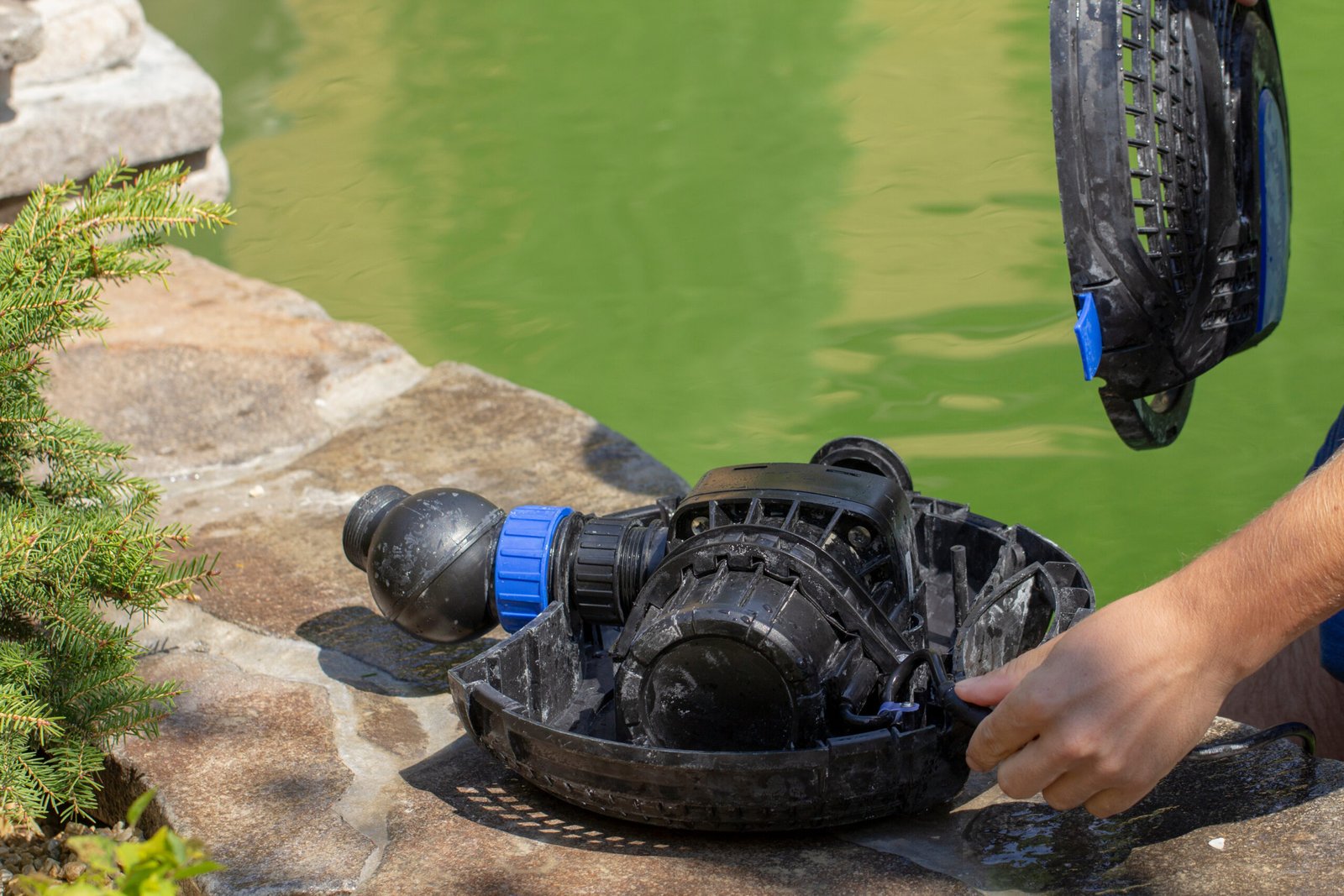
A submersible pump inside the pond pushes water into a filter positioned above water level. The filtered water then returns to the pond by gravity, often via a waterfall.
Pressurised canister filters can be buried underground and return water under pressure. However, they may struggle to adequately filter a heavily stocked 2,000-gallon koi pond.
Gravity-Fed
The filter sits at pond level and is typically buried flush with the ground. It connects to the pond via bottom drains and/or surface skimmers. A pump in the final chamber returns clean water back to the pond.
Gravity-fed systems are generally preferred for larger, heavily stocked koi ponds.
10 Top Tips for Effective Koi Pond Filtration
-
Research thoroughly before designing your pond and filter system.
-
You cannot over-filter — when in doubt, add more filtration capacity.
-
Allow your filter time to mature. Stock gradually and ensure ammonia and nitrite remain at zero during the first three months.
-
Prioritise strong mechanical filtration, especially if using a UV clarifier.
-
Calculate filter volume including the space taken up by media.
-
Ensure adequate oxygen supply for beneficial bacteria — consider adding air stones.
-
Remove trapped waste regularly to prevent oxygen depletion.
-
Design for easy maintenance (drains to waste, auto top-ups, accessible chambers).
-
Eliminate dead spots and ensure even water distribution through all media.
-
Always verify pump performance at the required head height before purchase.
With thoughtful design, patience during maturation, and regular maintenance, your filtration system will provide stable water quality and a healthy environment for your koi.